From Hackathon Challenge to Auditable AI Research — Claude Code + Momen Visual Backend

I developed this project for Hack the Law Cambridge 2026, responding to Clifford Chance's challenge: "How Do We Supervise Legal AI Agents?"
The core problem: while legal teams increasingly use AI for initial research, the genuine challenge involves oversight. As I framed it, "the hard part is not generation. It is supervision: seeing what the agent did, challenging the output, and keeping an audit trail a partner can stand behind."

Project Overview
I scoped an internal legal research supervision tool where "AI drafts a cited report; a human iterates through self-review; a leader approves or rejects. Every round and every AI step is preserved."
The distinguishing approach: the entire backend runs within Momen's visual interface, while the React frontend connects through Momen BaaS — a visual, Postgres-native backend that AI coding tools and no-code builders plug into. You configure your data model, logic, AI agents, and permissions visually, and it exposes a standard GraphQL API your frontend consumes. One backend, many frontends.
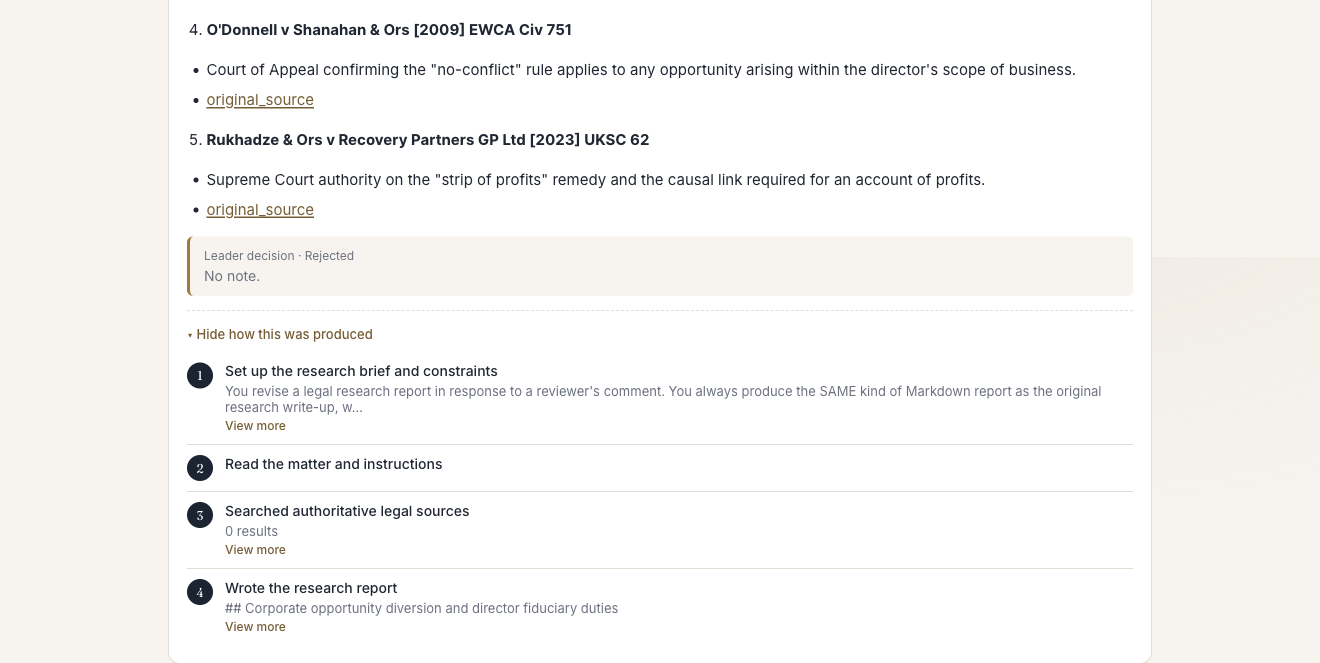
Matter Detail Screenshot
The Problem Being Solved
Traditional partner-review models assume human-only teams. When AI agents operate at scale, "supervision needs a system — not just a checklist."
The backend requirements included:
Traceability — complete round history without silent overwrites
Accountability — documented initiation and approval chains
Transparency — exposed AI queries and tool calls accessible through data rather than buried logs
Frontend Architecture
Rather than building within Momen's canvas, Claude Code generated a React frontend consuming the backend via Momen BaaS — a single GraphQL API over everything configured in the editor.
To connect Claude Code to the backend, I installed the Momen plugin — it gives Claude Code direct access to your tables, Actionflows, AI agent schemas, and permissions, so there's no need to document the API manually:
# Claude Code
claude plugin marketplace add momen-tech-org/momen-nocode-plugin
claude plugin install momen-nocode@momen
When you sync the backend, the plugin re-introspects the live schema and your generated code stays correct.
Key Resources:
Backend Architecture Overview
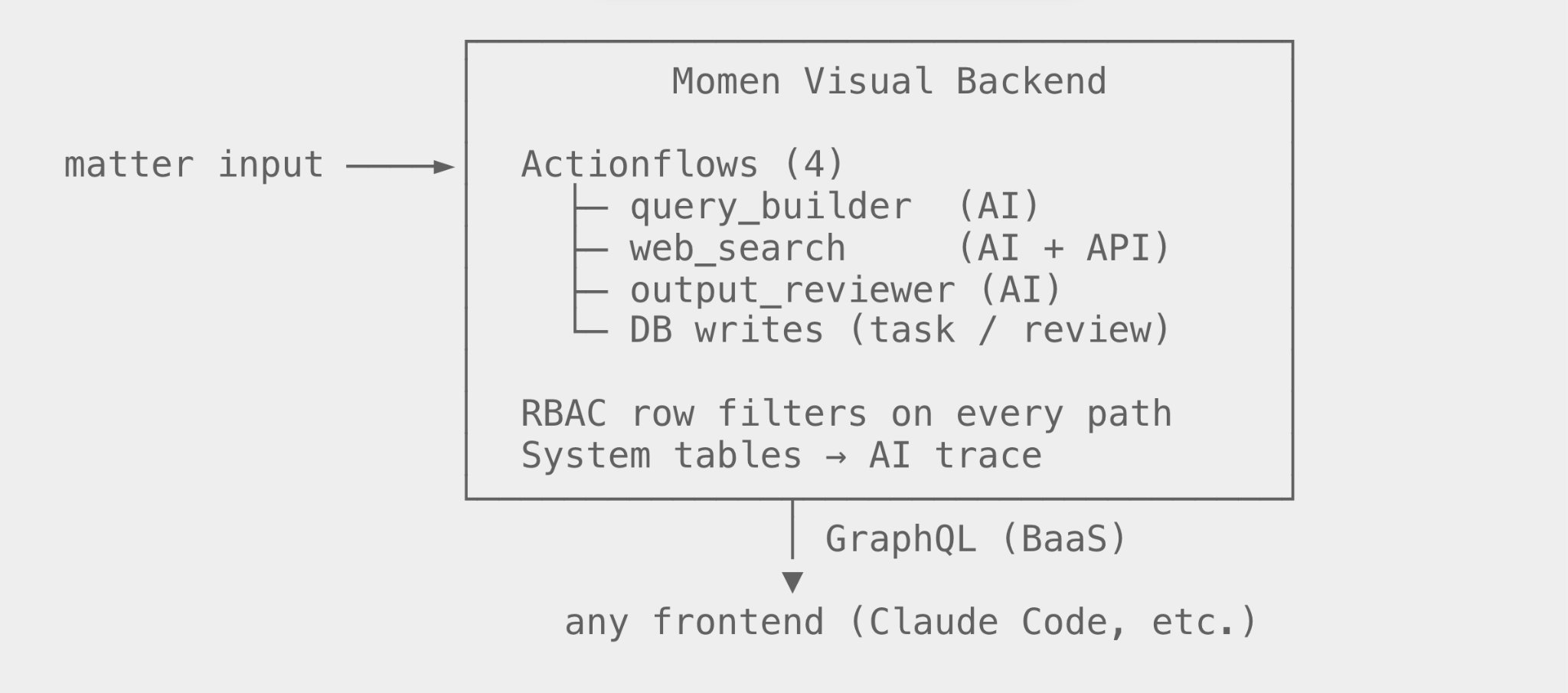
Core Principle: "a review round is an immutable record. The AI never updates an existing report in place. Each iteration inserts a new review row."
Data Model Structure
task (Matter):
Field | Type | Purpose |
|---|---|---|
title | TEXT | Generated from matter by query_builder |
input | TEXT | The legal question |
query | JSONB | Prepared search queries (process data) |
initiator | → account | Matter opener |
review (Self-Review Round):
Field | Type | Purpose |
|---|---|---|
output | TEXT | Markdown report (insert-only, never updated) |
comment | TEXT | Initiator feedback triggering next round |
time | BIGINT | Round sequence marker |
task_status | → task_status | Approved/Rejected/In Progress/In Review |
conversation_id | BIGINT | Links to AI trace in system tables |
task | → task | Parent matter reference |
leader_review | 1:1 | Leader sign-off record |
leader_review (Sign-Off):
Field | Type | Purpose |
|---|---|---|
comment | TEXT | Optional decision note |
time | BIGINT | Decision sequence |
self_review | 1:1 → review | One decision per round |
Supporting Tables:
task_status— lookup rows: Approved, Rejected, In Progress, In Reviewaccount— Momen built-in user table extended with self-relation (account.leader_id → account.id)
Derived State (by Convention):
Current matter status =
task_statuson the latestreviewrowRound count = number of
reviewrows for that task
Permission Model (RBAC)
Role | Backend Rule |
|---|---|
Initiator | Has leader_id set; can manage own matters and review rounds |
Leader | Has subordinates; can read subordinates' In-Review rounds and write leader_review |
Unbound | No leader/subordinates; actionflows reject; no data access |
"Access control is entirely server-side. Row-level filters in Momen Permission Management decide what each role can read and write."
Related Documentation:
AI Agents
Three specialized agents handle discrete tasks:
Agent | Input | Output | Role |
|---|---|---|---|
query_builder | Matter text | Structured JSON (title, queries) | Transform legal question into search plan |
web_search | task_id | Markdown report | Search, score, select sources, write cited report |
output_reviewer | last_output_id, comment | Markdown report | Revise or re-search based on feedback |
Search Implementation: The web_search agent calls Perplexity API (configured via API Integration), passes queries from the task, and applies domain filtering from config.config_json. The agent selects the top 5 results and writes first-person Markdown without AI-voice phrasing.
Revision Process: output_reviewer determines whether feedback requires new sources or in-place revision, then produces output similarly.
Documentation:
AI Transparency (System Tables)
Rather than custom logging infrastructure, the system leverages Momen's built-in tables. Each review stores conversation_id, which chains into:
review.conversation_id
  → fz_conversation
    → fz_message
      → fz_message_content (text/json payloads)
      → fz_tool_usage_record (tool call requests/responses)
"Any client connected via BaaS can query the chain and reconstruct what the agent did — queries sent, sources returned, reasoning steps — without custom logging infrastructure."
AI Transparency Architecture
Actionflows (Workflow Orchestration)
All mutations flow through Actionflows — no direct client table inserts for AI output. Four flows manage the complete lifecycle:
Actionflow | Mode | Inputs | Effect |
|---|---|---|---|
first-output-for-self-review | async | task_input | Run query_builder → insert task → web_search → insert first review |
self-review-for-next-output | async | task_id, comment | Save comment → output_reviewer → insert new review |
self-review-to-leader-review | sync | task_id | Set latest round status to In Review |
leader-review | sync | task_id, task_status_id, comment | Set Approved/Rejected + insert leader_review |
Async vs. Sync Logic: AI-invoking flows run asynchronously server-side; clients wait via GraphQL subscriptions. Status transitions remain synchronous — single transactions without AI overhead.
Immutability Enforcement: self-review-for-next-output inserts new review rows rather than updating prior ones, guaranteeing frozen report text at creation.
Documentation:
Third-Party Integration: Perplexity
"Legal research needs live web search against authoritative domains." Perplexity integrates as a third-party API within Momen's API Integration interface — not embedded in application code.
The web_search agent calls it with:
query— array of search stringssearch_domain_filter— from configmax_results,search_context_size— tuned for legal snippets
Requests and responses populate fz_tool_usage_record, feeding the transparency chain.
Documentation:
BaaS: Connecting the Frontend
After backend sync, the visual schema becomes a typed GraphQL API. The Momen plugin lets Claude Code read this schema directly — tables, nested relations, Actionflow inputs/outputs, and AI agent schemas — without any manual API documentation.
Capability | Implementation |
|---|---|
Authentication |
|
Reads | Auto-generated queries per table + nested relations |
Writes |
|
AI Trace | Query |
Real-time | WebSocket subscriptions on actionflow task status |
"The schema is self-documenting via introspection — no hand-written API spec."
Related Builds:
Backend Design Decisions
Decision | Rationale |
|---|---|
New | Provides native audit trail; satisfies non-destructive history requirement |
No status column on | Single source of truth (latest review) eliminates sync bugs |
| Separates process data from user-facing deliverables |
Dedicated | Adjust search scope without redeploying agents |
| Models hierarchy without extra org tables |
Actionflows as sole write path | Centralizes RBAC enforcement; prevents client-side pipeline bypass |
| Enables transparency via system tables rather than custom logging |
Perplexity in API Integration | Keeps third-party search in visual backend, not frontend code |
Implementation Timeline
Component | Time |
|---|---|
Data model + relations + config seed | ~1 hour |
3 AI agents + Perplexity wiring | ~2 hours |
4 Actionflows + RBAC | ~2 hours |
Sync, test, iterate | ~1 hour |
Backend Total | ~4–6 hours |
Momen Free plan supports hackathon MVPs; Perplexity charges per search.
Conclusion
"For Hack the Law's supervision challenge, the backend is the product." The visual architecture delivers:
Immutable review history through table design
Guarded AI output pipeline via Actionflows
Complete reasoning transparency linked to system tables
Server-side RBAC enforcement
"What matters here is that the backend is complete, visual, and auditable — without a line of server code."
