UI Generators vs Full-Stack Builders: What Non-Technical Founders Actually Need

Typing a prompt and getting a beautiful user interface in 30 seconds feels like magic. But the moment you add real users, process payments, or try to handle complex relational data, that magic often turns into a debugging nightmare.
Founders are increasingly hitting the "80% wall." Rapid AI code generators excel at building the "dining room" (the UI). However, they struggle to architect the "kitchen" (the secure, scalable backend).
This introduces severe "Comprehension Debt." You end up owning a codebase your entire business relies on, but that you cannot read, trace, or fix when it inevitably breaks.
To launch a successful software startup today, speed is not enough; you need architectural control. This article will break down the fundamental differences between rapid UI generators and structured full-stack builders, providing a framework to help you choose a tech stack that won’t force a costly rebuild.
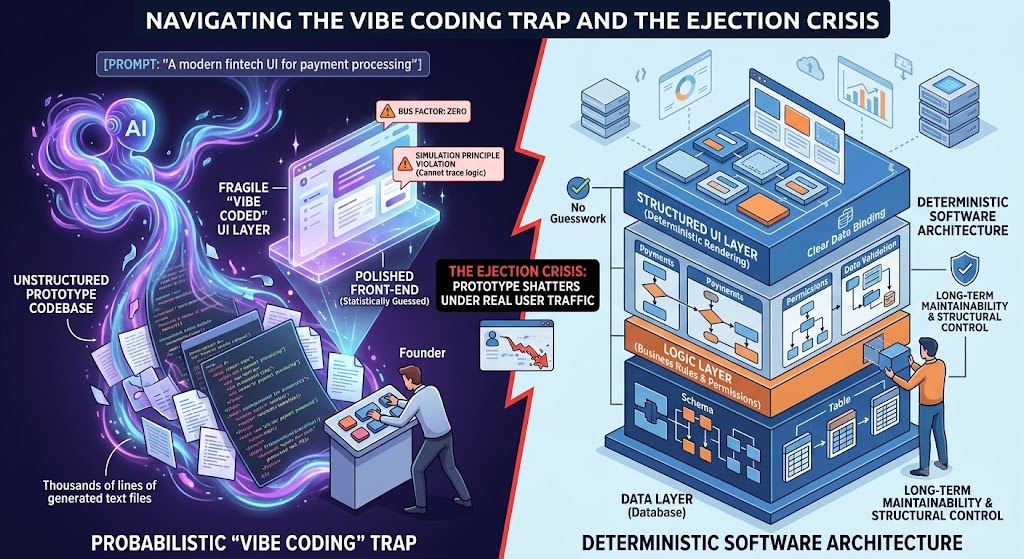
Navigating the Vibe Coding Trap and the Ejection Crisis
The recent shift toward "vibe coding" tools—rapid UI generators like Lovable, Bolt.new, and v0—has dramatically lowered the barrier for early-stage design. These tools allow builders to generate polished front-end code simply by describing an idea.
However, there is a massive difference between probabilistic AI generation and deterministic software architecture. AI is fundamentally a guessing machine; it predicts the most likely next line of code based on vast patterns.
Commercial software requires strict, unbending rules. Critical functions like payment processing, database updates, and user permissions cannot rely on a statistical best guess.
When you rely entirely on these generated text files, you violate the "Simulation Principle." If you cannot mentally trace or visually understand the thousands of lines of code the AI creates, your startup has a bus factor of zero.
Across builder communities, a recurring theme is that AI tools accelerate initial prototyping but often create severe challenges for long-term maintainability. Users frequently report getting stuck in endless debugging loops, spending time and credits trying to fix logic in a codebase they do not understand.
This lack of structural control inevitably leads to the "Ejection Crisis." This is the painful moment a founder must rewrite their entire application from scratch because the unstructured prototype shatters under real user traffic.
The Structural Litmus Test for Production-Ready AI Builders
Before committing your business to an AI app platform, you need a decision framework to evaluate if the tool is truly production-ready. You can evaluate structural integrity using three core tests.
The "Double-Booking Test" (Concurrency)
If two users try to purchase the exact same item at the exact same millisecond, the platform must securely reject the duplicate request at the database level.
The "Bank Transfer Test" (Atomicity)
Does the platform support atomic transactions and safe rollbacks? If a multi-step workflow fails halfway through, the system must revert safely rather than leaving data in a broken, intermediate state.
The "Glass Wall Test" (Server-Side Row-Level Security)
Does the platform enforce true server-side Row-Level Security (RLS)? Simply hiding unauthorized data on the front end leaves your application exposed to anyone inspecting the browser.
The Cost of Fragile Architectures
Rapid UI generators typically rely on fragile frontend logic or unstructured JSON blobs to handle these scenarios. This approach lacks the strict constraints required to process secure operations at scale.
When platforms rely too heavily on automated frontend generation and unconstrained AI code completion, quality and security often degrade. For instance, research from GitClear’s 2025 AI Copilot Code Quality study indicates a staggering 8x increase in code duplication in AI-assisted codebases. This pattern of copy-pasting code fragments without structural architecture is exactly what causes modern applications to break under the pressure of the Concurrency and Atomicity tests.
Furthermore, ignoring server-side RLS and relying on thin client-side validation introduces massive vulnerabilities. According to Veracode’s GenAI Code Security Report, nearly 45% of code produced by Large Language Models (LLMs) across standard benchmarks contains functional security flaws, leaving applications open to exploits like Broken Access Control and Injection attacks.
In contrast, full-stack builders enforce these rules natively using robust relational databases like PostgreSQL. By managing state and access policies directly on the database engine, you eliminate the risk of AI-generated security gaps.
To see a transparent view of how to properly configure server-side data models and logic, review our guide on How to Build Apps with Momen.
The Hybrid Workflow and Two-Way Translatability
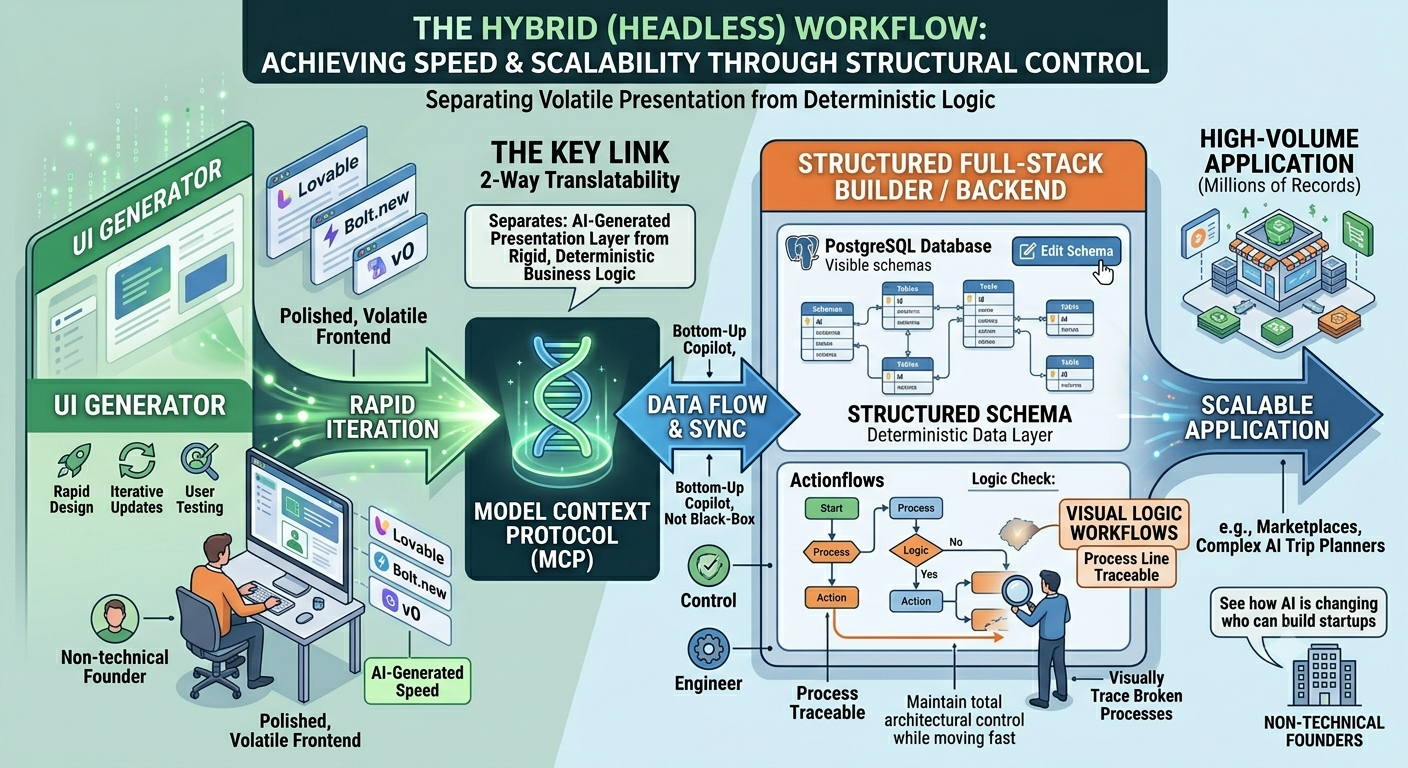
You do not have to choose between AI generation speed and structural integrity. The modern solution for building scalable applications is the "Hybrid (Headless) Workflow."
Founders are increasingly using rapid generators like Lovable to quickly design, test, and iterate frontend experiences. Once the interface is validated, they can connect it to Momen's backend through the Lovable Connector or directly through Momen's Cursor MCP integration, allowing AI-generated frontends to communicate with structured business logic and databases without requiring a complete rebuild.
This workflow separates the volatile, AI-generated presentation layer from the rigid, deterministic business logic that powers the application.
The approach is enabled by what we call Two-Way Translatability. Instead of acting as a black-box code generator, AI becomes a bottom-up copilot that helps builders create visible, editable database schemas, workflows, and application logic.
Every workflow, data relationship, and automation remains inspectable. If a process breaks, builders can visually trace where the logic disconnected, identify the root cause, and make changes without digging through thousands of lines of generated code. This preserves architectural control while maintaining the speed advantages of AI-assisted development.
With this foundation, non-technical founders can build and scale sophisticated applications—including marketplaces, internal business systems, SaaS platforms, and AI-powered trip planners—capable of handling large datasets and complex operational workflows, all without writing traditional backend code.
This structural foundation allows non-technical builders to construct high-volume applications without writing manual syntax. For example, using Momen's visual Actionflows and native PostgreSQL, a non-technical founder recently built a sports card marketplace supporting 5.1 million SKUs, 50,000 users, and $1M in revenue. Similarly, complex agentic apps—like our live AI Trip Planner—can execute multi-step external API calls seamlessly.
See how a non-technical founder applied these principles to build an application managing millions of records in our breakdown of How AI Is Changing Who Can Build Startups.
Architecting a Business You Completely Control
AI app builders give non-technical founders unprecedented leverage. However, prioritizing sheer UI generation speed over structural backend integrity inevitably leads to unmaintainable technical debt.
The goal of launching a startup is to architect a scalable, reliable business that you completely understand and control. You do not need to know how to write syntax to achieve this.
What you do need is a technology stack built on real relational databases, transparent data structures, and business logic you can actually see. In Momen, founders can visually design their database schema and map out backend processes using Actionflows—Momen’s proprietary visual logic engine.
Rather than hiding critical business operations behind generated code, Actionflows allow you to visually define how data moves through your application, from user authentication and payments to notifications and approvals. Because Actionflows are natively ACID-compliant, every transaction is executed with the consistency and reliability expected of production systems. In other words, they pass the "Bank Transfer Test": either an operation completes successfully, or it doesn't happen at all.
This level of transparency gives founders something most AI-generated applications lack: control. When your startup begins to scale, you can understand, audit, modify, and extend the underlying logic without untangling thousands of lines of generated code.
Solid visual architecture is the engine that keeps your application running securely under pressure. Instead of spending months trapped in an endless debugging cycle, you can focus on building products, serving customers, and growing your business.
Ready to architect a business you completely control? Try Momen's AI Copilot to visually generate your database schema, build backend logic with Actionflows, and launch on a production-ready foundation from day one.

