Momen at NYU Shanghai: Building a Working AI App Live in 90 Minutes

On September 11, 2026, Momen ran a 90-minute session at NYU Shanghai called Vibe Coding 101: Build a Working App in 90 Minutes (No Code Required!), co-hosted with the university's Center for Career Development. Most of it was one live build, narrated as it happened.
The CCD is NYU Shanghai's career office, providing career guidance to students and alumni, working with employers, and running everything from coaching and career fairs to entrepreneurship support. Momen brought the speaker, the live build, and $100 in Momen credits for every attendee to keep building afterwards.
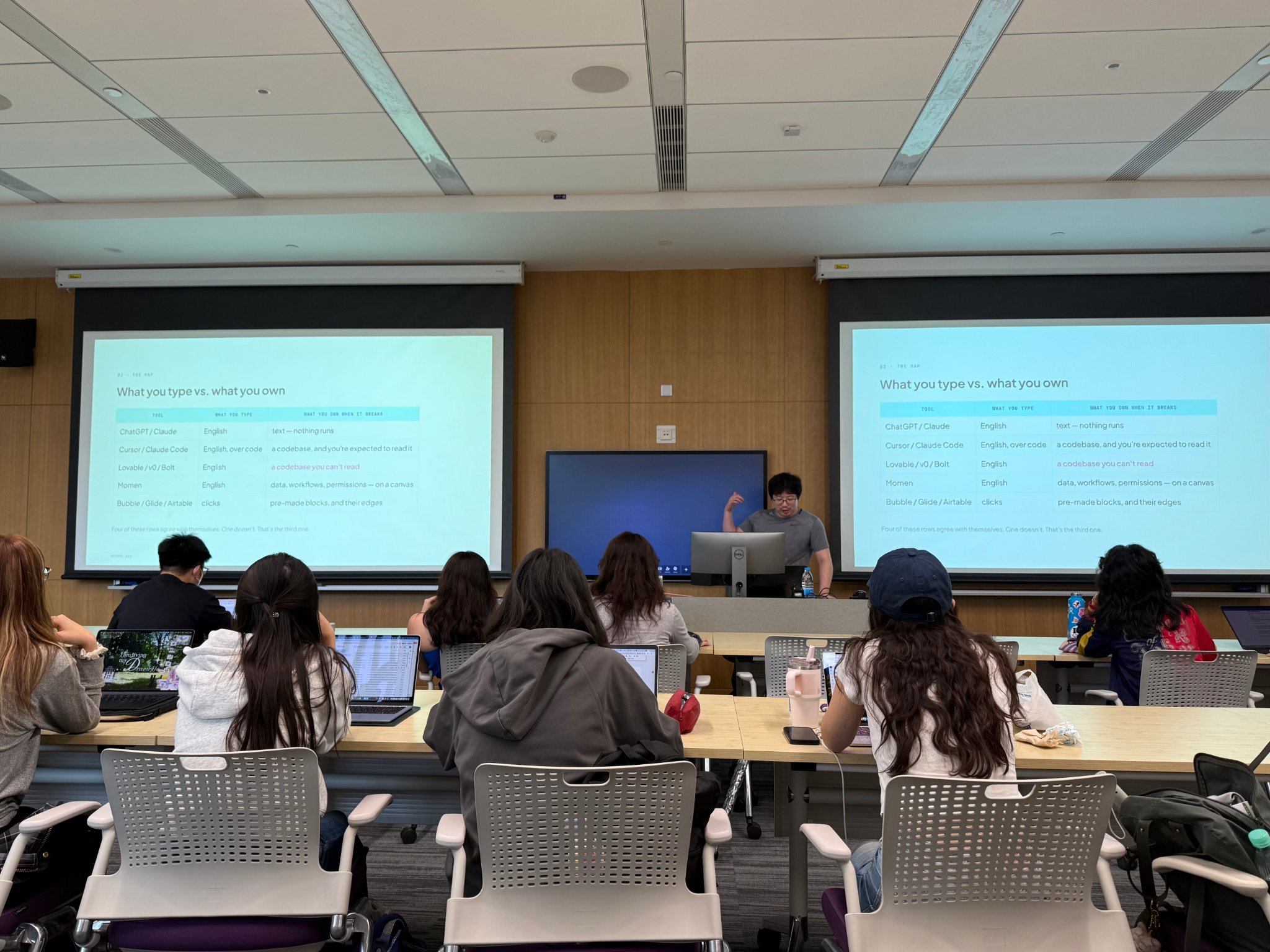
Twenty Minutes on Which Tool to Reach For
Yaokai Jiang, founder of Momen, opened with three questions. Who has asked ChatGPT or Claude to write code for you? Keep your hand up if you built something with Cursor, Lovable, v0 or Bolt. Keep it up if that thing still runs today.
Hands go down between the second question and the third, and the reason is that a screen is not an app. Every viral demo ends the moment something appears on screen. Accounts, stored data, and who is allowed to see what — none of that is in the demo, and all of it decides whether the thing survives to day three.
So the tools got graded on one column: what you're holding when something breaks.
Tool | What you own when it breaks |
|---|---|
ChatGPT / Claude | text — nothing runs |
Cursor / Claude Code | a codebase, and you're expected to read it |
Lovable / v0 / Bolt | a codebase you can't read |
Momen | data, workflows, permissions — on a canvas |
Bubble / Glide / Airtable | pre-made blocks, and their edges |
The third row is the one that catches people out. You describe the app in plain language and receive ten thousand lines you cannot read, which is where the fix-break cycle starts. The tool isn't the trap; owning something you can't read is.
That row is also the distinction the build ran on. Vibe coding is AI on code. Vibe no-coding is AI on no-code — same language in, but what lands is a canvas you can open and change, not a codebase.
Momen's own limit was on the same slide: one good-looking page in ninety seconds? Use v0. Don't use us. Momen is worth the setup when the thing has to still be there next month.
Restyle: The App Built On Stage
The build was Restyle. Someone uploads a photo, picks one of six art styles — The Claymation Look, Neo-Noir Cinematic, 90s Anime Nostalgia, Cyberpunk 2099, Porcelain & Kintsugi, 8-Bit Pixel Art — and an AI agent redraws the photo in that style, showing the original and the result side by side. Everything a person generates collects further down the same page, newest first, visible only to them.
Try the live app · Open in Momen editor / Clone project

Upload a photo, pick a style, get a picture back. That part is easy, and that part is not the app. The app is the three things underneath it:
What gets made has to be stored, and still be there tomorrow.
Every AI call costs money, so there has to be a limit per person. In the paid version that's credits — three to start, five more for five US dollars through Stripe.
Each person sees their own images, and nobody else's.
Nothing was assembled by hand. The whole thing started as a single written brief pasted into Momen's AI Copilot, which generated the data model, the Actionflows, the AI agent call, the access rules and the Stripe integration.
Two things about Copilot mattered for a room watching. It builds backend first — tables, logic and permissions before any screen — so the parts that decide whether an app survives are the parts that show up first, not the ones bolted on after the demo looks good. And what it produces is the editor itself: every table it created can be opened, every workflow followed step by step, every rule clicked and changed. Correcting it is a sentence in the same chat or a direct edit on the canvas, not a prompt-and-pray retry against a file nobody can read.
The styles are stored as two separate fields: a name, which is all anyone ever sees, and an instruction, which is what actually reaches the image model along with the photo. Changing how a style looks means editing a row, not rebuilding anything.
The credit rule runs in two halves — check what somebody has left before starting any work, then take one off only once an image has actually come back. Nobody pays for a failure, and nobody gets a free generation out of one. A failed attempt shows a message on screen and writes nothing down at all.

And signing in is enforced by the app rather than by the interface. An unauthenticated visitor still sees the whole page — the styles, the upload box, the button — and is stopped at the moment of generating, because hiding a button is not the same as enforcing a rule.
Open Restyle and Clone It
Everything built on stage is open. The editor link opens the finished project — the tables, the AI agent, the Actionflows, the permission rules and the Stripe setup — and it can be cloned into your own account, so the app the room watched get built becomes a starting point rather than a screenshot.
The written brief that produced it is public too, which means the build can be repeated from zero: paste it into AI Copilot and watch the same backend appear, or edit the wording first and get a different app out.
Open in Momen editor / Clone project
Read the full Restyle brief and build prompt
Why This Format Works for Universities
Students followed the build on their own laptops, which is most of why this format travels: nothing has to be installed, and nobody loses the first twenty minutes to environment setup. The project is open to clone and the credits cover the AI calls, so the same build can be repeated alone afterwards, or pointed at a different idea.
Momen works with universities, student organizations, developer communities, hackathons and incubators — hosting workshops, sponsoring events, mentoring teams and judging. Students and educators get 50% off through Momen's education plan.
If you run a program and want a session like this one, get in touch at hello@momen.app.

