How to Choose a Backend in the AI-Building Era (2026 Scorecard): Supabase vs Firebase vs Momen vs Xano vs Bubble

By Yaokai Jiang · Published June 18, 2026 · Talk delivered at No Code Week Frankfurt
I want to give you a bit of context before diving in. I gave this talk at No Code Week in Frankfurt on June 18, 2026, as part of the Open Mic session. The room was full of founders who build with AI and no-code tools — people who are shipping real products without necessarily reading every line of code underneath. And the question I wanted to answer was the one nobody was asking clearly enough: when your AI can spin up a backend in an afternoon, how do you know if you've picked the right one?
I built a scoring framework. I ran seven platforms through it across nine criteria, out of 100 points. I want to walk you through the whole thing — the framework first, then the scores, then the surprises. And yes, I'll tell you exactly where my own product, Momen, lands. It doesn't come first.
One disclosure before anything else: I do represent a company, so take whatever I say with a grain of salt, especially when it comes to my own platform. I tried to stay as objective as possible — I used incognito mode in the AI tool that did the analysis, and I gave it the framework without forcing any numbers on it.
The One Idea Worth Taking Home
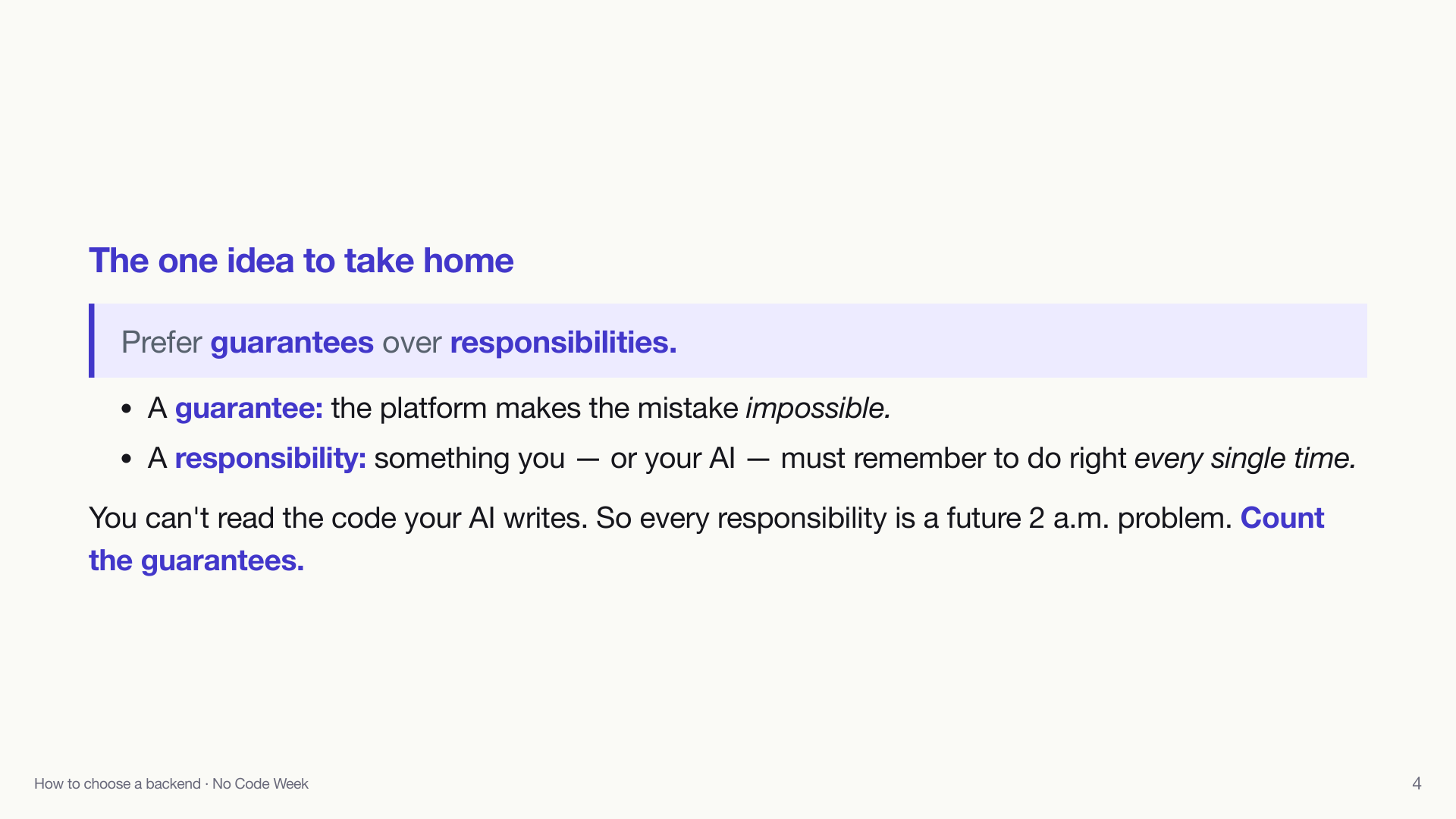
If there's one thing you want to take away: ensure the backend or platform you choose gives you guarantees instead of responsibilities.
The difference matters. A responsibility is something you — or whatever is doing the programming — has to remember to do every single time. If the permission check is done at the beginning of every workflow, you have to configure it to do the actual check, to reject unauthorized users — that's a responsibility. Because you, or the AI, has to do that correctly every single time.
A guarantee is something you configure once and it's cross-cutting. It behaves correctly no matter who touches it next — the next person could be a human, could be an AI that creates a new workflow, adds a new field to a table — things still work.
You can't read the code your AI writes. So every responsibility is a potential 2 a.m. problem. Count the guarantees.
This is why backend structure always matters, even if you don't write code. The platform is the safety net — not the prompt.
The Framework: Nine Things That Matter
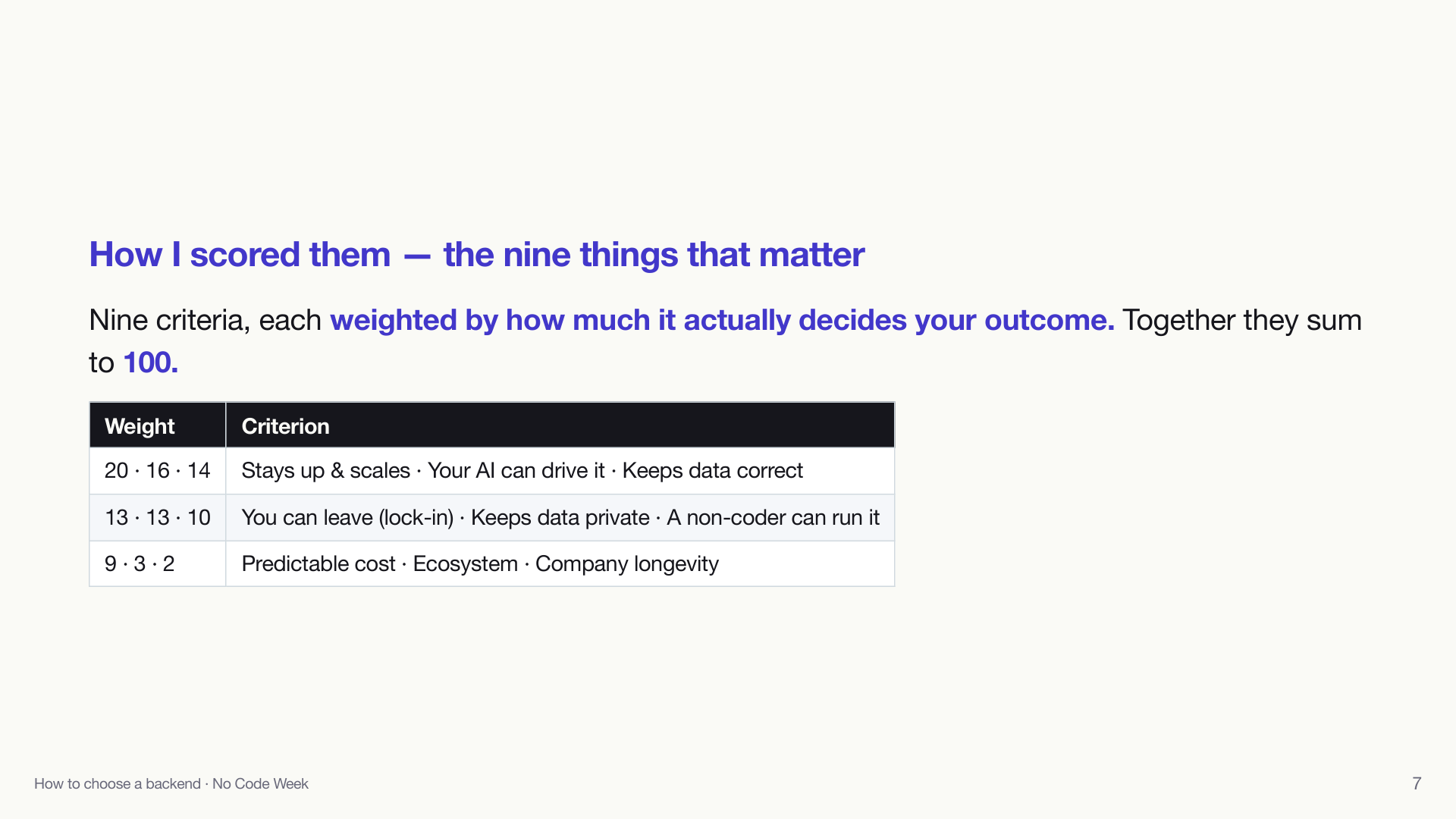
I broke the evaluation down into nine criteria, weighted by how much each actually decides your outcome. Together they sum to 100:
Stays up & scales (20) — obviously, if your backend doesn't stay up, it's not a system.
Your AI can drive it (16) — if you're not a coder, can your AI drive it?
Keeps data correct (14) — correctness, which I'll go deep on.
You can leave / lock-in (13)
Keeps data private / security (13)
A non-coder can run it (10)
Predictable cost (9)
Ecosystem (3)
Company longevity (2)
I score each sub-item 0 to 5, adjust by weight, and sum to a number out of 100. Then there are disqualifiers — fatal weaknesses on survival-critical items that cap the entire total, no matter how well the platform performs elsewhere. A cap means no average can rescue it.
The Five That Carry the Most Weight
1. Correctness
There are platforms — and I'll name one shortly — that will lose updates when you simultaneously call multiple PATCH requests. PATCH is the HTTP method that modifies an existing record. If you fire a bunch of patches on the same record at the same time, there's a chance some of them go missing. That's called the lost update problem. And it's insidious, because it only happens when you have lots of users. By the time it surfaces, it's very difficult to trace back what actually happened.
Think of it like this: I'm setting my name to "Yao Kaijian" at the same moment someone else is setting my address. I end up with the old name but the new address — or the other way around. That's bad. It's very hard to detect. You can ask an AI to find evidence of it, but make sure you instruct it to do deep research.
The other thing people don't pay enough attention to is consistency. And this is where I have to criticize MongoDB and Firebase. People choose them because of schemalessness — they think it means flexibility. But behind every freedom is a responsibility. Without enforced schema, you now have to ensure all the data in your database conforms to what you think it is. Does every record have a name field? Is every price a number or a string with a dollar sign attached? There's no guarantee.
Nowadays, you can get an AI to build a proper schema in about 15 tokens — that's essentially free. I don't see the reason to forgo that guarantee anymore. Two years ago, if you hadn't studied databases, you might not know how to create a proper table. But today, that's commodity. MongoDB and Firebase don't give you that guarantee by default.
The double-booking problem is one of the most painful examples of this in the wild. Here's a deep dive into how it plays out in no-code — and why the platform's data model is the only real fix.
2. Scale
Think in orders of magnitude: 1, 10, 100, 1,000, 10,000, 100,000, then a million — beyond which you probably shouldn't be doing this alone anyway.
But here's the thing people get wrong: most products don't need extreme scale. I'm a shipping company, 10,000 users — pretty respectable. How much data do you think that generates? My guess is under 2 gigabytes of database per year. Your 1-terabyte machine lasts you 500 years. So unless you're dealing with hundreds of billions of rows, don't trade off correctness for scalability. The scale story is mostly a red herring for early-stage products.
3. Lock-in and Exit
Can I get out? I'd split this into a few dimensions: Can you export your data? Can you export your logic in a format that's common, not some proprietary domain-specific thing? Can you host it yourself? Can a hired developer take it over?
The ultimate form of no lock-in is all four. But at minimum, look for something that has an escape hatch — a place where you can drop in code. That alleviates the problem even if it doesn't eliminate it.
4. Cost
There's usually a gap between how platforms charge and how humans understand cost. Normal people don't think in GB-seconds or megabytes. We think: I have maybe 100 users, each with a few photos. Use AI to bridge that gap — have it build out user stories for your app, translate those into user flows, identify the five most common ones, and translate those into the actual operations the platform charges you for. We built a price calculator for Momen using exactly this breakdown.
Assume you think you'll have 100 users — estimate for 1,000 instead.
5. Security
Column-level security is something people often overlook. There are two ways to handle cases where one user should access some fields but not others: either create a separate table, or find a platform that supports both role-level and column-level security natively.
The Scores
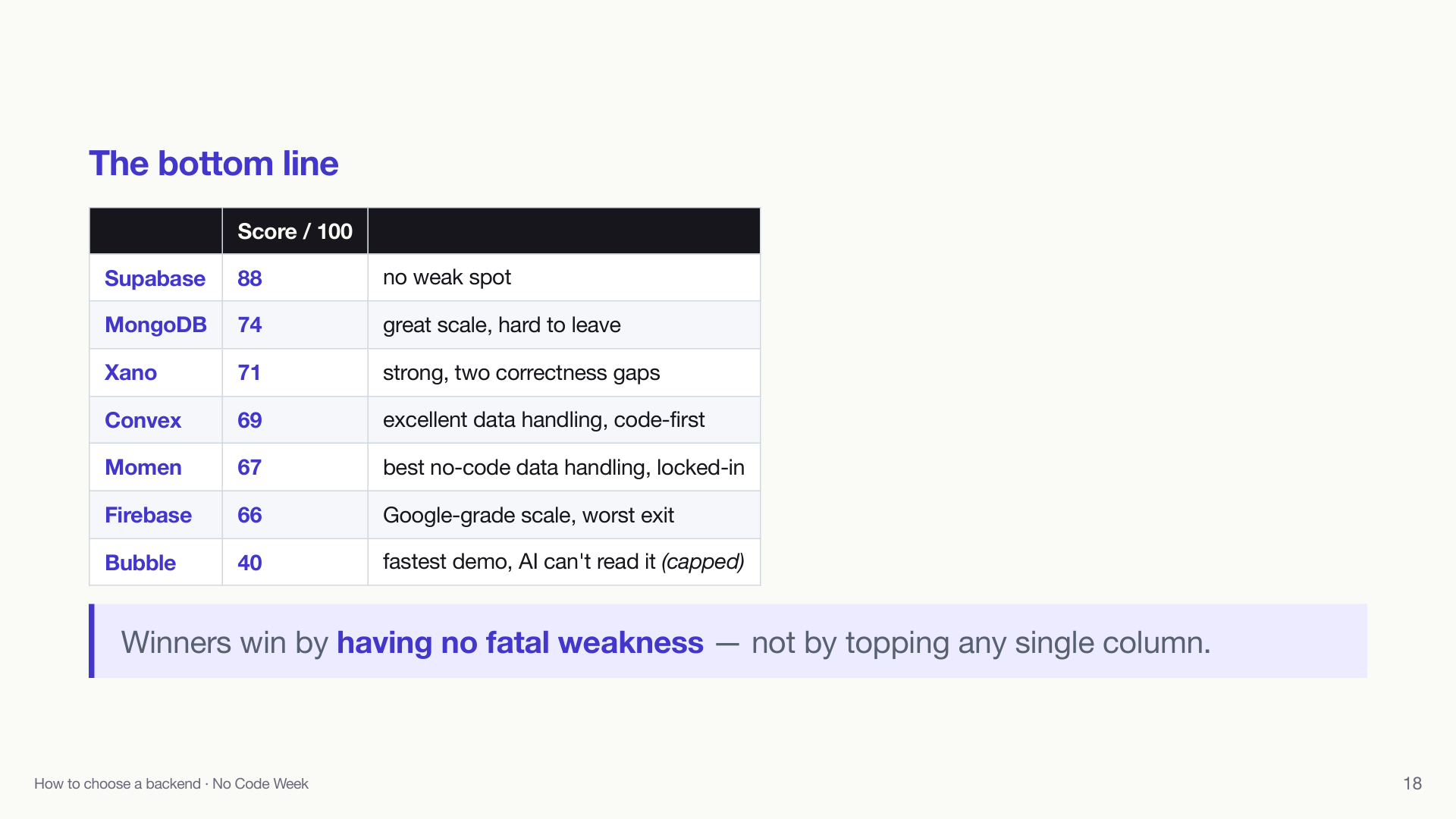
Here's how the seven platforms ranked, out of 100, for a multi-tenant app that handles payments:
Platform | Score | Summary |
|---|---|---|
Supabase | 88 | No weak spot |
MongoDB | 74 | Great scale, hard to leave |
Xano | 71 | Strong, two correctness gaps |
Convex | 69 | Excellent data handling, code-first |
Momen | 67 | Best no-code data handling, locked-in |
Firebase | 66 | Google-grade scale, worst exit |
Bubble | 40* | Fastest demo, AI can't read it (capped) |
Three Surprises
The winner has no peak
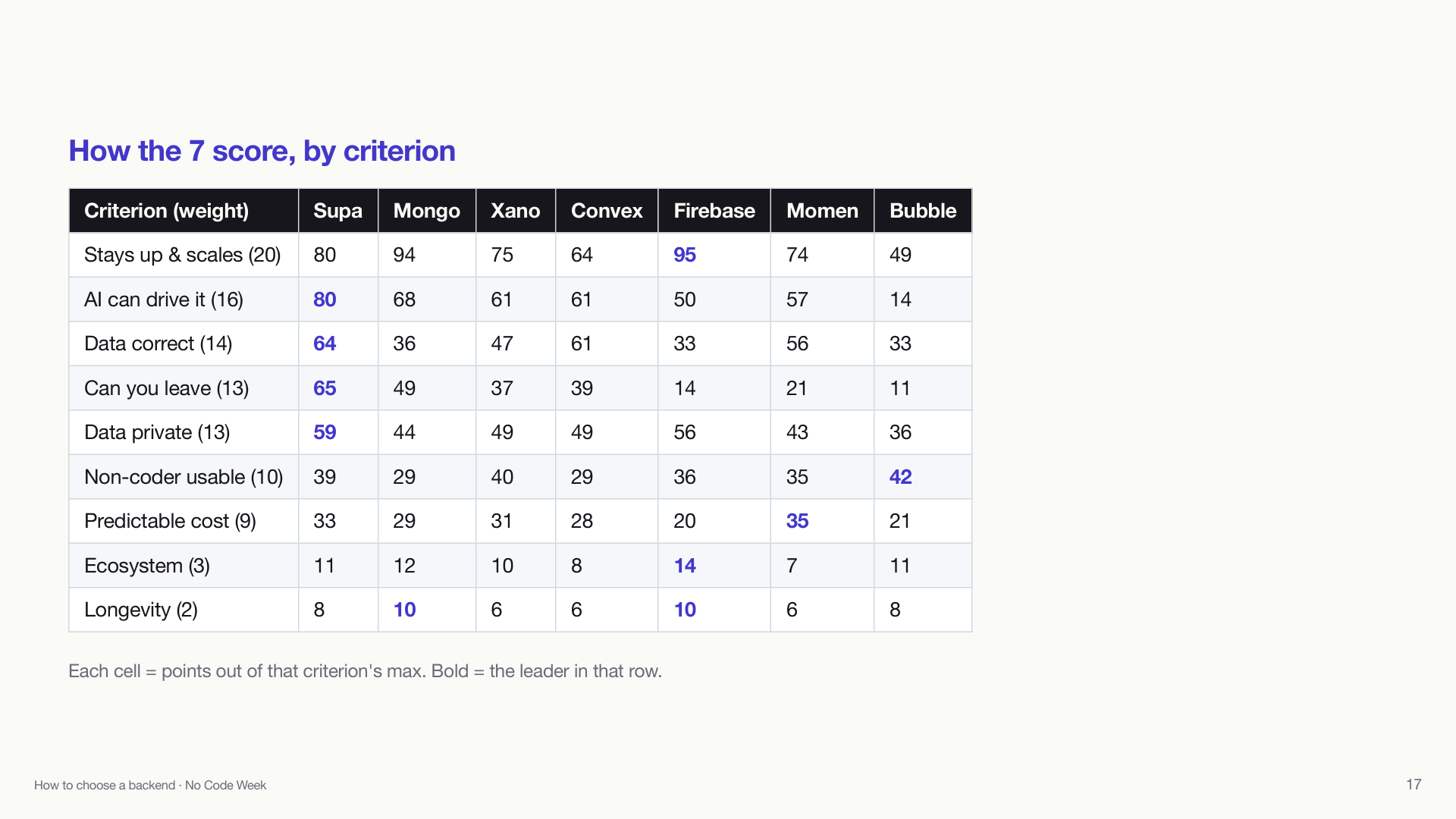
Supabase won at 88 — without winning the column everyone shops for. On raw scale, it's only 80. Firebase scores 95 on scale. MongoDB scores 94. They beat Supabase there easily. But Supabase wins by having no weak row — it never dips below roughly 60% on anything that matters.
Firebase and MongoDB, which you'd think are enterprise-grade, land mid-table — Firebase at 66, MongoDB at 74 — mainly because correctness and exit crater their scores. They were engineered in the early 2000s to overcome the limitations of a single computer. That's when "big data" was coined. That's what NoSQL was actually built for. Now we're using it to build apps for 10,000 users, which fits comfortably on a single machine. That tradeoff no longer makes sense.
The lesson: steady beats spiky. A backend with one fatal flaw is a fatal backend.
The friendliest tools scored worst
Bubble has the best usability of all seven — and is capped at 40, because an AI tool can't read or drive its visual logic. They were never intended to be used as a backend service, and they don't advertise themselves that way, so putting them in this list is a bit offensive. But it's an honest comparison.
Firebase and MongoDB score near zero on keeping data correct by default — schemaless means the rule-enforcing capability exists but is off by default, and it does nothing for the bad data already in your system.
Nice-by-default is not the same as safe-by-default.
This is the same trap described in Why "No Backend" Is a Myth in AI App Building — the app runs, it looks fine, and then something quietly breaks at scale.
The demo that lies to you
Xano passed every click-test I ran by hand. Then I had an AI write a roughly 15-line script firing around 100 edits concurrently — and it silently lost writes, even on edits to different fields of the same record. That's very few people would be able to tell you from normal use. I actually tested all these platforms myself as backends.
If you want to verify this yourself: ask an AI to write a concurrent test for 15 users hitting the same row, each writing a different value. You will see things go missing. It genuinely surprised me.
Manual two-tab testing almost never catches the millisecond race window. If you test concurrency by clicking, you are testing nothing.
Where My Own Tool Lands — Straight
Momen: 67, fifth out of seven.
We're best at keeping data correct among no-code visual backends. We use real relations in Postgres. We have the most predictable pricing in the group.
We're worst at lock-in. We don't let you export your logic — the configurations you build in our platform have no meaning outside it. We do let you export your data, but you can't self-host because we're not open source. That is why the score is where it is.
If you take nothing else away from this: Supabase has the highest market share for a reason. They're not there because they got lucky or did crazy marketing — I don't think they did too much marketing. They were just good. No fatal flaws, anywhere.
Making the Framework Your Own
You don't have to follow my methodology. It's a framework of thinking, and you should adjust the weights to match what you're actually building.
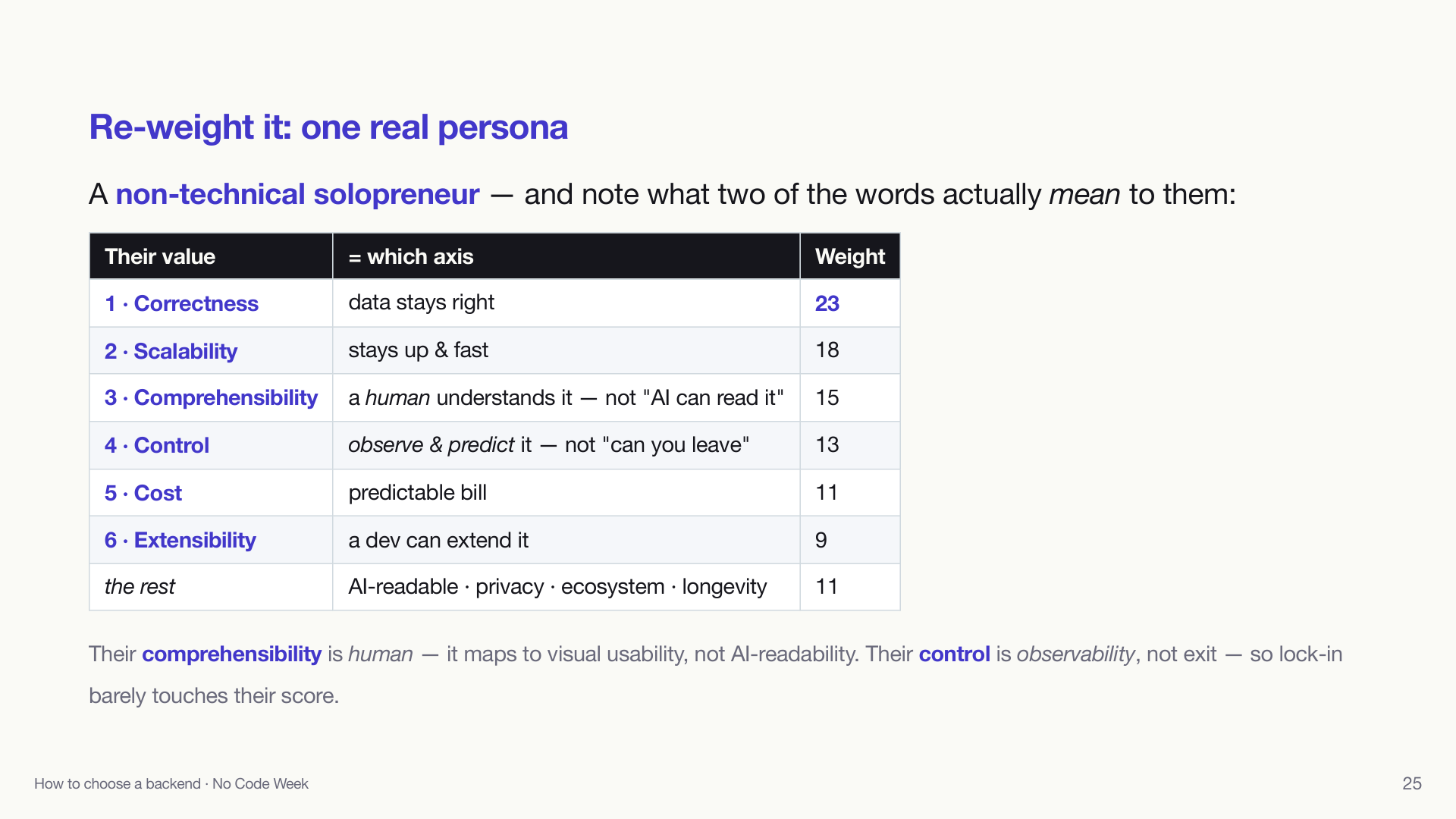
Let me show you what happens when I re-weight for a specific persona: a non-technical solopreneur who doesn't intend to hire a developer, who wants to own the whole build from beginning to end.
What does that person actually value?
Correctness (23) — you don't want something that goes wrong, because it's your name on it.
Scalability (18) — you want it to handle growth.
Comprehensibility (15) — having ownership of something means you understand it. If you don't understand it, you don't really own it. You're at the mercy of a third party, whether that's an AI or a contractor.
Control / Observability (13) — can you see what's going on? Can you predict things before they happen? That's the most important thing when you're programming — you're imagining things. Can you verify your imagination matches reality?
Cost (11) — predictable bill.
Extensibility (9) — can you plug things in, and can you take it out?
When I re-weight for this persona, Momen jumps up four points and ties with Xano at second. Supabase drops slightly because its two main strengths — AI-readability and exit — aren't what this person prizes.
I changed one word — "control" from can you leave to can you see what it's doing — and my own tool went from fifth to a tie for second. That's not cooked books. They're genuinely different questions. Decide which one you mean before you start scoring.
For non-technical founders deciding between AI coding tools and no-code, this breakdown is a useful starting point. The backend choice flows directly from which path you take.
How to Apply This
First, write down what you're building. This determines which disqualifiers apply to you.
Touching money, inventory, or bookings? Correctness becomes pass/fail. If the platform doesn't offer transactional semantics, don't use it. You will get burned at some point.
Storing other people's personal data? Security becomes pass/fail.
Real-time? Pick Convex.
Regulated (health, finance)? You need appropriate compliance certifications.
Then score, apply the disqualifiers, and decide. Below roughly 65, or any disqualifier triggered, means "not a real product on this platform" — not "needs a little work."
Test it yourself in about 30 minutes:
Simultaneous writes — have your AI write a 15-line script firing ~100 updates at once. Do all of them land?
Two accounts — can you open one user's data while logged in as another?
Export — can you download all your data, right now?
Cost — model 10x your expected users. What's the bill? Is there a cap?
Exit — could a freelance developer take this over next month?
Watch for red flags. If you ask a vendor about limits and they say "you don't need to worry about that" — that's usually a sign they're not comfortable with the question. Good documentation tells you the limits, not just the wins. Engineering is all about tradeoffs. If you don't know the limits, you don't know when to make the tradeoff.
The Pocket Guide
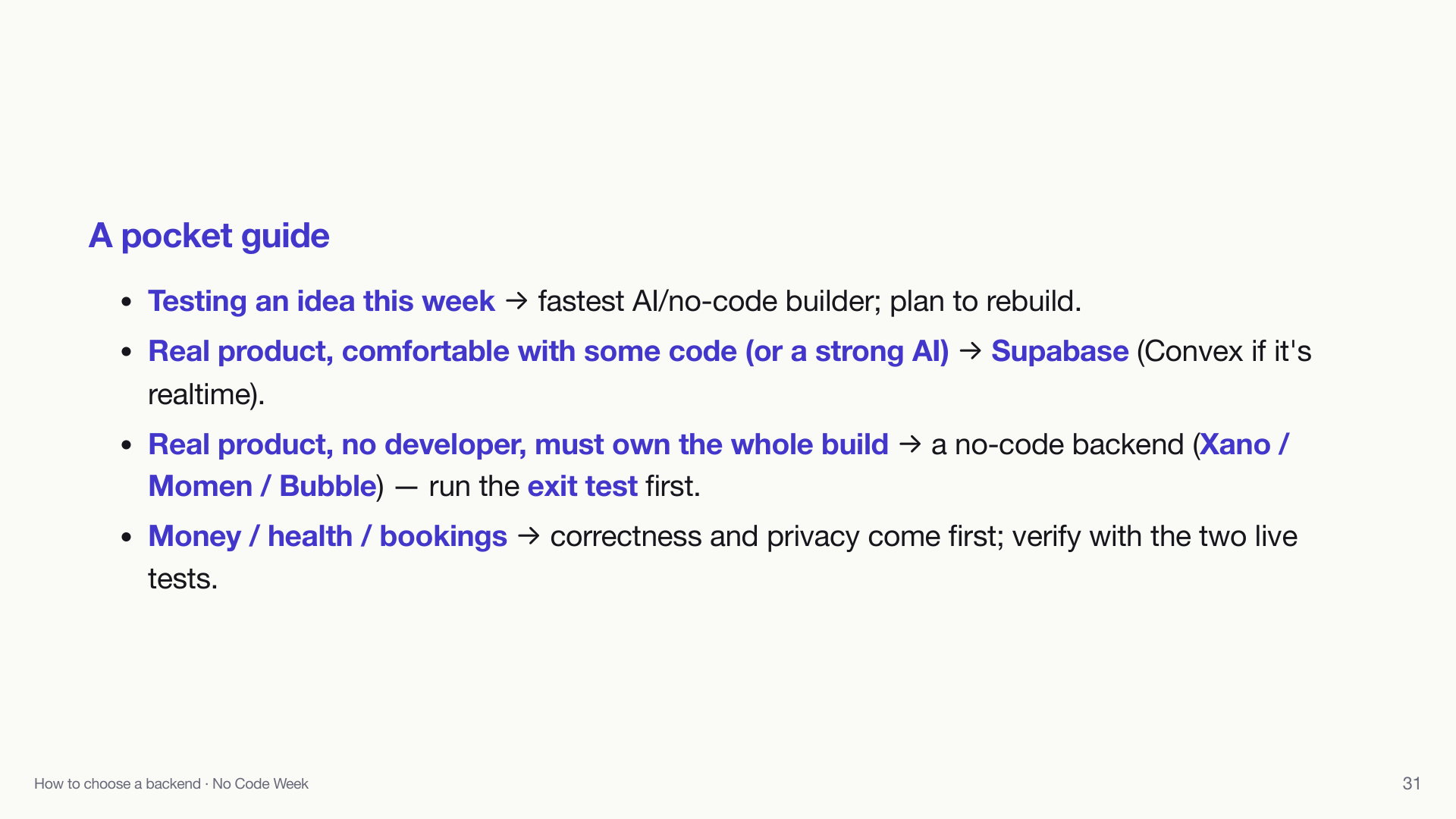
Testing an idea this week → fastest AI/no-code builder; plan to rebuild.
Real product, comfortable with some code → Supabase. Convex if it's real-time.
Real product, no developer, must own the whole build → a visual no-code backend (Xano, Momen, Bubble) — run the exit test first.
Money, health, or bookings involved → correctness and privacy come first; verify with the two live tests above.
If you're still comparing your options at the broader AI builder level, this guide to the top AI app builders in 2026 covers the prototype-vs-production trap that most comparisons miss. And if you're specifically thinking about going beyond vibe coding, this piece on building for real data and workflows is worth the read.
One Last Line
Guarantees over responsibilities. Make the right thing the default — because neither you nor your AI will remember it every time.
The full scorecard — all 9 criteria, every sub-item score, and the disqualifier rules — is at docs.momen.cloud/how-to-choose-a-backend.
Yaokai Jiang is the Founder & CEO of Momen, a visual full-stack no-code platform.

